Centralized ESG Compliance: Track And Manage Sustainability
Use centralized ESG compliance software to track sustainability goals, streamline reporting, monitor performance, and ensure regulatory responsibility.
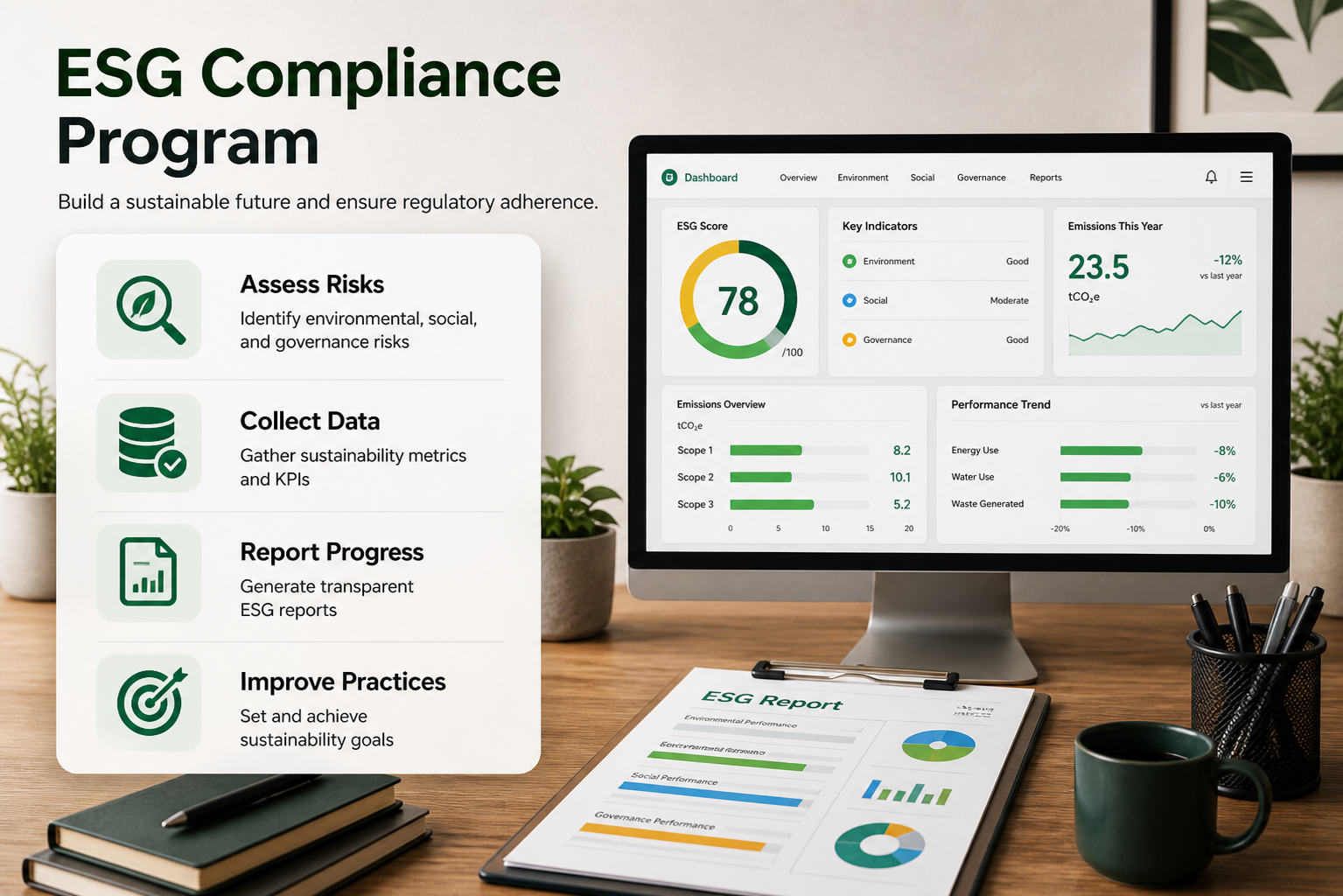
The category of technology now described as an ESG compliance management system represents a material conceptual advance over the earlier generation of ESG reporting tools. Where reporting platforms Workiva, Persefoni, Watershed, IBM Envizi, and their peers concern themselves principally with the downstream production of disclosures, an ESG compliance management system is concerned with the upstream governance infrastructure that makes those disclosures reliable: the policies that have been attested to, the controls that have been tested, the risks that have been assessed, the issues that have been remediated, and the regulatory changes that have been tracked and acted upon.
This guide examines what ESG compliance management systems do, how they relate to existing governance, risk management, and compliance (GRC) platforms, which vendors lead the market, and what the category costs in the United States as of 2026. It is addressed to chief risk officers, chief compliance officers, internal audit leaders, and IT GRC programme managers who are evaluating whether to extend an existing GRC platform to cover ESG or to purchase a dedicated ESG management system.
The distinction is most clearly expressed through the analogy of financial controls. An organisation does not merely produce financial statements; it maintains a system of internal controls over financial reporting documented, tested, and attested to that gives those statements their credibility in the eyes of auditors and regulators. An ESG compliance management system performs the equivalent function for ESG data. It is the controls layer that sits beneath the reporting layer, ensuring that every number in the disclosure has a documented origin, a named owner, an approved calculation methodology, and a tested control.
ESG reporting software produces the annual sustainability statement. The ESG compliance management system governs the processes and controls that make that statement assurable. Dakota Software's 2025 analysis articulates the relationship precisely: "ESG management and reporting software provides the infrastructure to continuously monitor, manage, and improve ESG performance," a description that encompasses controls, issues, policies, and risk, not merely data aggregation and disclosure.
An enterprise-grade ESG compliance management system should provide, as a minimum viable specification, the following capabilities drawn from an assessment of MetricStream, SAI360, ServiceNow, and GAN Integrity product documentation:
Policy management and attestation. A centralised library of ESG policies covering environmental management, human rights, anti-corruption, labour practices, and whistleblower protections with lifecycle management, version control, and tracked attestations from relevant stakeholders.
Controls design, testing, and evidence management. A control library aligned to COSO ERM or ISO 37301, with scheduled testing workflows, evidence attachment, deficiency logging, and remediation tracking. This is the capability that assurance providers examine under CSRD and SB 253 limited-assurance engagements.
ESG risk register and materiality assessment. An enterprise risk register that accommodates climate transition risk, physical climate risk, human-rights due-diligence findings, modern-slavery risk, DEI-related reputational risk, and governance failures, scored on inherent and residual bases consistent with the organisation's existing enterprise risk management methodology.
Issue tracking and remediation workflows. End-to-end management of ESG non-conformances, audit findings, regulatory citations, and supplier non-compliances, with assigned owners, escalation rules, and target resolution dates.
Regulatory change management. A continuously updated regulatory content library ideally AI-assisted that ingests new and amended ESG laws, translates them into compliance obligations, and triggers action plans for affected business units.
Third-party and supplier ESG due diligence. Supplier assessment questionnaires, continuous monitoring against sanctions and adverse media, integration with external ratings networks (EcoVadis, Sedex), and documentation aligned to CSDDD due-diligence requirements.
Audit trail and data lineage. A complete, tamper-evident record of every data entry, calculation change, approval, and disclosure event within the system the primary evidence base for assurance providers.
Board and executive reporting. Real-time dashboards presenting ESG KRIs alongside financial and operational risk metrics, enabling the Board and Audit Committee to exercise meaningful oversight.
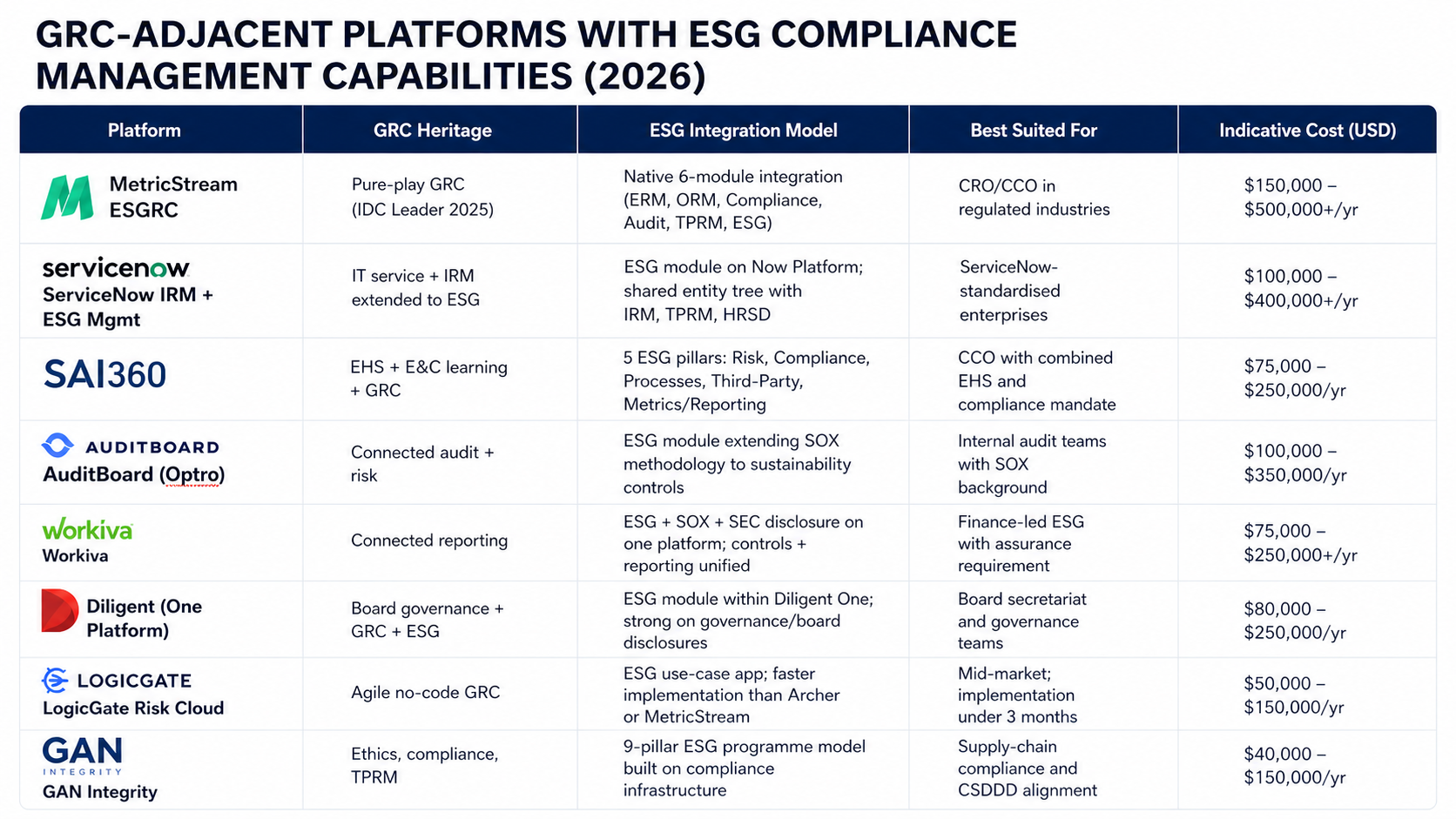
A detailed comparison of GRC-adjacent platforms offering ESG compliance capabilities.
Platform | GRC Heritage | ESG Integration Model | Best Suited For | Indicative Cost (USD) |
|---|---|---|---|---|
MetricStream ESGRC | Pure-play GRC (IDC Leader 2025) | Native 6-module integration (ERM, ORM, Compliance, Audit, TPRM, ESG) | CRO/CCO in regulated industries | $150,000 – $500,000+/yr |
ServiceNow IRM + ESG Mgmt | IT service + IRM extended to ESG | ESG module on Now Platform; shared entity tree with IRM, TPRM, HRSD | ServiceNow-standardised enterprises | $100,000 – $400,000+/yr |
SAI360 | EHS + E&C learning + GRC | 5 ESG pillars: Risk, Compliance, Processes, Third-Party, Metrics/Reporting | CCO with combined EHS and compliance mandate | $75,000 – $250,000/yr |
AuditBoard (Optro) | Connected audit + risk | ESG module extending SOX methodology to sustainability controls | Internal audit teams with SOX background | $100,000 – $350,000/yr |
Workiva | Connected reporting | ESG + SOX + SEC disclosure on one platform; controls + reporting unified | Finance-led ESG with assurance requirement | $75,000 – $250,000+/yr |
Diligent (One Platform) | Board governance + GRC + ESG | ESG module within Diligent One; strong on governance/board disclosures | Board secretariat and governance teams | $80,000 – $250,000/yr |
LogicGate Risk Cloud | Agile no-code GRC | ESG use-case app; faster implementation than Archer or MetricStream | Mid-market; implementation under 3 months | $50,000 – $150,000/yr |
GAN Integrity | Ethics, compliance, TPRM | 9-pillar ESG programme model built on compliance infrastructure | Supply-chain compliance and CSDDD alignment | $40,000 – $150,000/yr |
Use this comparison to evaluate platforms based on integration depth, use case, and budget fit.
The integration of ESG risk into the enterprise risk management (ERM) framework is the aspect of ESG compliance management systems that most distinguishes them from standalone reporting tools. Where a reporting platform asks "what do we disclose?" an ERM-integrated management system asks "what are the financial, operational, and reputational consequences of our ESG exposures?" The two questions are related but not identical, and the governance apparatus they require is materially different.
Platforms designed for ERM integration, including ServiceNow IRM, MetricStream ESGRC, and AuditBoard, enable ESG risks to be added to the enterprise risk register using the same inherent-residual-target scoring methodology applied to financial, operational, and cyber risks. Climate transition risk the financial exposure arising from regulatory, market, and technology changes associated with the low-carbon transition and physical climate risk the exposure arising from extreme weather and chronic climate shifts are scenario-analysed using TCFD-aligned or ISSB S2-aligned pathway models, and quantified in dollar terms using expected-loss or value-at-risk methodologies consistent with the organisation's existing risk appetite framework. The result is a consolidated risk reporting view in which the Board can observe ESG key risk indicators alongside credit, liquidity, and operational risk metrics without context-switching between systems.
The practical implication for procurement decisions is significant: organisations that have invested heavily in ServiceNow IRM, MetricStream, Archer, or AuditBoard have a strong strategic reason to extend those platforms to cover ESG rather than deploy a separate reporting-only tool. The incremental licensing cost is typically lower than a standalone purchase, and the data-governance benefits of a unified platform single entity hierarchy, shared control library, consolidated audit trail are considerable.
The regulatory obligations that most directly require a management-system approach as distinct from a point-in-time reporting exercise are those which impose ongoing due diligence and control obligations rather than merely periodic disclosure. The EU CSDDD, which will apply to the largest EU and non-EU companies from July 2029 (following the scope revision effected by Omnibus I), requires documented human-rights and environmental due-diligence processes embedded in business operations, not merely an annual disclosure. Germany's Supply Chain Due Diligence Act (LkSG), in force since 2023 and partially to be superseded by CSDDD transposition by July 2028, imposes analogous requirements on its in-scope entities, with fines reaching 2% of global annual turnover. The California SB 253 assurance requirement creates a parallel demand: the controls infrastructure must exist before the assurance engagement, not be assembled in response to it.
The standards that provide the conceptual architecture for ESG compliance management systems include ISO 14001 (Environmental Management Systems), ISO 26000 (Social Responsibility), ISO 37301 (Compliance Management Systems), and ISO 45001 (Occupational Health and Safety). While these certifications are not legally required under CSRD or SB 253, they are recognised as evidence of systemic compliance governance by assurance providers and procurement teams, and they inform the control-framework design of leading GRC platforms.
An enterprise software platform that operationalises ESG obligations through ongoing policies, controls, risk assessments, attestations, issue and remediation workflows, and audit trails not merely periodic disclosure. It typically sits inside or integrates with a GRC or IRM platform so that ESG obligations are governed with the same rigor as financial, operational, and cyber risk.
ESG reporting software produces disclosures. An ESG compliance management system governs the controls, policies, risk assessments, and issue-management workflows that make those disclosures accurate and assurable. Reporting platforms such as Workiva, Persefoni, and IBM Envizi emphasise downstream disclosure; management systems such as MetricStream ESGRC, ServiceNow ESG Management, and SAI360 emphasise upstream governance.
Primary owners are the CCO, CRO, internal audit, GRC programme manager, and CSO. Data contributors include facilities and EHS (energy, emissions, waste), HR (DEI, safety incidents, training), procurement (supplier ESG assessments), finance (carbon-adjusted financial metrics), legal (regulatory obligations), and IT security (cyber governance). The Board risk and audit committee are the primary consumers of the system's reporting outputs.
ESG risks climate transition, physical climate, human rights, modern slavery, DEI, cyber-privacy, and governance failures are added to the enterprise risk register with inherent and residual scoring, linked to controls and key risk indicators (KRIs), and reported to the Board alongside financial and operational risks. Platforms designed for this integration include ServiceNow IRM and ESG Management, MetricStream ESGRC (100% integrated across six GRC modules), AuditBoard, and Archer.
Enterprise GRC platforms with ESG modules typically range from one hundred and fifty thousand to seven hundred and fifty thousand US dollars or more per year, with implementation services at comparable cost. Mid-market bundles (AuditBoard, LogicGate, OneTrust, Diligent) commonly run seventy-five thousand to two hundred and fifty thousand US dollars annually. Point ESG tools (Persefoni, Watershed, Sweep) typically fall in the thirty thousand to one hundred and twenty thousand US dollar range. All figures require a scoping engagement before formal quotation.
For organisations already standardised on ServiceNow IRM, MetricStream, AuditBoard, or Archer, extending the existing platform to cover ESG is typically more cost-effective and yields superior data-governance outcomes (unified entity hierarchy, shared control library, consolidated audit trail). For organisations without a mature GRC platform, a purpose-built ESG management system or a combined ESG-reporting-and-controls platform (Workiva, Diligent) is generally the more practical starting point.
Use centralized ESG compliance software to track sustainability goals, streamline reporting, monitor performance, and ensure regulatory responsibility.
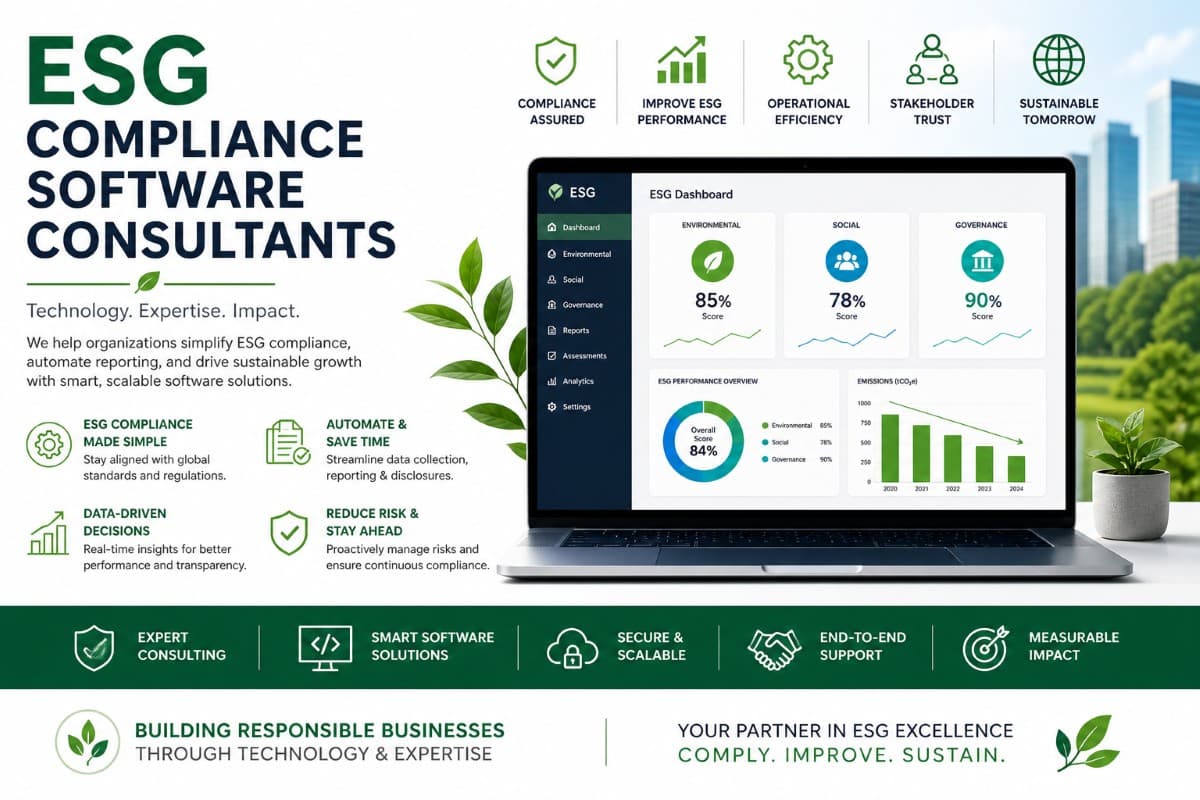
Looking for ESG consultants? Learn what they do, how they work, and how ESG compliance software helps businesses manage reporting, risks, and audits.
Explore real thoughts on compliance software, its role in risk management, audits, and how ESG compliance software helps businesses stay organized and ready.
Learn how to manage compliance with simple systems, clear workflows, and ESG compliance software to stay audit ready and reduce risk across your business.