Centralized ESG Compliance: Track And Manage Sustainability
Use centralized ESG compliance software to track sustainability goals, streamline reporting, monitor performance, and ensure regulatory responsibility.
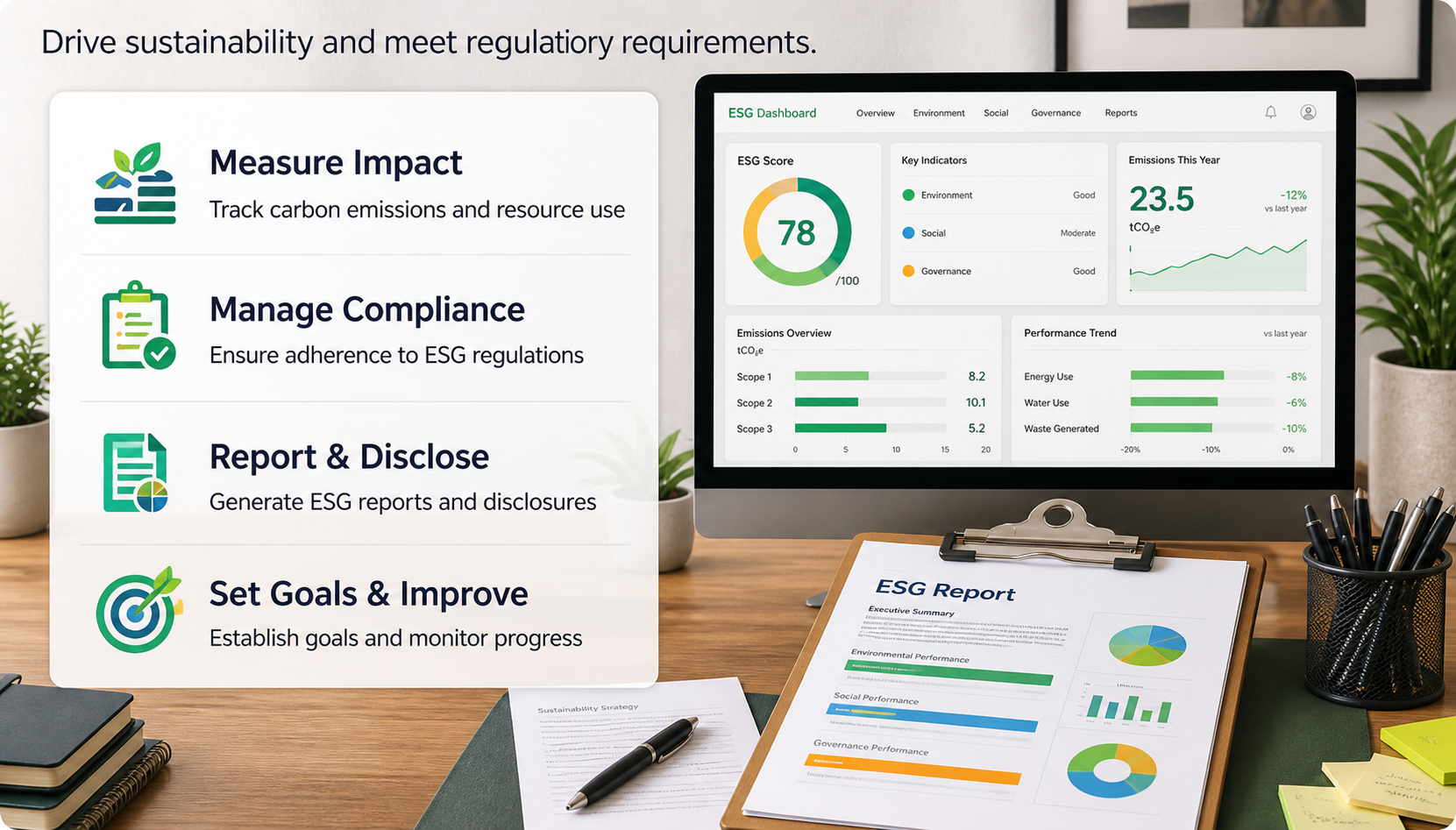
ESG compliance in the United States is no longer optional; it's becoming a reporting requirement. With increasing pressure from the SEC, state regulations such as California’s climate disclosure laws, and growing investor scrutiny, businesses are expected to track, audit, and report ESG data accurately. Manual processes don’t hold up anymore, especially when audit trails, emissions data, and supplier risks are involved.
This is where ESG compliance software comes in. The right platform helps finance and compliance teams centralize data, maintain audit-ready records, and align with US regulatory frameworks without slowing down operations.
This guide examines what ESG compliance solutions are, how they differ from ESG reporting software, which vendors lead the market in the United States as of 2026, and what regulatory obligations are driving procurement decisions. It is addressed principally to compliance officers, sustainability leaders, and risk executives in organisations subject to California SB 253, the EU's Corporate Sustainability Reporting Directive (CSRD), or the International Sustainability Standards Board (ISSB) frameworks.
ESG compliance solutions are integrated offerings that combine technology platforms, curated regulatory content, and in many cases advisory or managed services to help organizations meet their environmental, social, and governance disclosure and due diligence obligations. The definition is deliberately broad, and for good reason: the solutions category encompasses a more heterogeneous set of offerings than the software-only market.
A working definition, synthesized from vendor positioning and analyst commentary, holds that an ESG compliance solution is "a comprehensive approach and program of tools and processes for accountability, risk management, stakeholder engagement, and third-party oversight" (GAN Integrity, 2025). This framing is instructive precisely because it resists reduction to software alone. The distinguishing characteristic of a solution, as opposed to a platform, is that it assumes partial responsibility for compliance outcomes rather than merely enabling the customer to pursue them independently.
The terminological distinction between ESG compliance solutions and ESG compliance software, whilst superficially arcane, carries considerable commercial and operational significance. ESG software as exemplified by Workiva, Persefoni, Watershed, IBM Envizi, and their peers is a software-as-a-service product. It provides modules, workflows, and data infrastructure, but the substantive work of programme design, regulatory interpretation, materiality assessment, and assurance preparation remains the customer's responsibility.
ESG compliance solutions, by contrast, typically bundle three or more of the following components into a single commercial relationship: the software platform itself; a proprietary library of pre-mapped regulations, frameworks, and standards maintained by the vendor's research team; supplier engagement or third-party risk monitoring networks; advisory capacity in the form of regulatory experts or dedicated customer-success specialists; and, in some cases, managed data collection or assurance-preparation services. Vendors positioned explicitly as solutions providers include GAN Integrity, Aravo, Compliance and Risks, Waystone, QIMA, EcoVadis, and the ESG practices of the large professional-services firms.

Regardless of which category of provider a purchasing organisation considers, the following capabilities should be regarded as the minimum viable specification for an enterprise-grade ESG compliance solution in 2026:
Multi-framework regulatory mapping. Automated alignment to CSRD/ESRS, ISSB IFRS S1 and S2, California SB 253/261 (SB 261 currently stayed, CARB advises continued preparation), GRI Standards, SASB, TCFD, GHG Protocol, CDP, EU Taxonomy, and CSDDD due diligence requirements.
Scope 1, 2, and 3 emissions tracking. A calculation engine covering all fifteen GHG Protocol Scope 3 categories, with supplier engagement tools to address the documented challenge of value-chain data collection. See carbon accounting for methodological background.
Double materiality assessment tooling. Required under CSRD/ESRS; must support both impact materiality (outside-in) and financial materiality (inside-out) assessments with documented stakeholder evidence.
Third-party and supplier ESG risk management. Pre-built questionnaire libraries, supplier portal access, adverse-media monitoring, and integration with ratings networks such as EcoVadis and Sedex.
Audit trail and data lineage. Every data point must be traceable to source, owner, collection date, and calculation methodology to satisfy assurance providers operating under CSRD's limited-assurance requirement (effective FY2025 reports) and California SB 253's assurance schedule.
Regulatory horizon scanning. A continuously updated regulatory content library, ideally AI-assisted, that alerts users to material changes in applicable obligations. Compliance and Risks (2025) documented 1,533 ESG regulatory changes in the first half of 2025 alone — a volume no internal compliance team can monitor manually.
Disclosure and reporting outputs. XBRL/iXBRL tagging for digital regulatory submission (CSRD/ESRS), pre-built narrative templates, and investor-facing summaries aligned to CDP and investor-rating agency expectations.
An overview of ESG software categories and how different solutions fit across the market.
Solution Category | Typical Positioning | Representative Vendors | Primary Buyer |
|---|---|---|---|
Integrated GRC + ESG | Full governance, risk, and compliance suite extended to ESG | GAN Integrity, MetricStream, SAI360, AuditBoard, ServiceNow | CRO / CCO |
Connected Reporting (Finance-led) | Financial-grade ESG disclosure aligned to SEC/CSRD/ISSB | Workiva, DFIN, Lucanet, Certent, IRIS Carbon | CFO / Controller |
Carbon / Climate Specialists | GHG Protocol-aligned Scope 1/2/3 and decarbonisation planning | Persefoni, Watershed, Sweep, Greenly, Normative, Plan A | CSO / Head of Sustainability |
EHS-Rooted Platforms | Environmental, health, and safety extended to ESG reporting | Sphera, Cority, Enablon (Wolters Kluwer), Intelex | EHS Director |
Regulatory Content + AI | AI-driven horizon scanning and compliance action plans | Compliance and Risks, Datamaran, IntegrityNext | Compliance Manager |
TPRM / Supplier Networks | Third-party ESG risk, Scope 3 data, supply-chain due diligence | EcoVadis, Aravo, Sedex, GAN Integrity, QIMA | CPO / Procurement Lead |
Stack-Native (ERP / Cloud) | ESG data extracted natively from enterprise systems | SAP Sustainability Control Tower, Microsoft Sustainability Mgr, Salesforce Net Zero Cloud | CIO / CFO |
Advisory + Technology Bundles | Consulting-led with proprietary platform; managed outcomes | EY ESG Compass, Deloitte GreenLight, Waystone, KPMG | CEO / Board |
Use this overview to identify the right category based on your business needs and buyer role.
The table below presents the principal vendors evaluated for this guide, drawn from Verdantix Green Quadrant (2025), ISG Sustainability Compliance (2025), IDC MarketScape GRC (2025), and direct review of vendor positioning. Pricing is indicative; all vendors require a scoping engagement before issuing a formal quote.
Vendor | Primary Strength | CSRD/ESRS | SB 253 / CA | TPRM / Scope 3 | Indicative Annual Cost (USD) |
|---|---|---|---|---|---|
Workiva | Finance-grade connected reporting, XBRL/iXBRL, SOX integration | Yes (ISG Leader) | Yes | Via Carbon module | $75,000 – $250,000+ |
IBM Envizi | Operational ESG data at scale; energy, emissions, sustainability | Yes | Yes | Partial | $60,000 – $200,000+ |
SAP Sustainability Control Tower | ERP-native; S/4HANA integration; ESRS and EU Taxonomy | Yes (deep) | Yes | Via SAP procurement | SAP contract-dependent |
Persefoni | Rigorous GHG Protocol accounting; audit-grade Scope 1/2/3 | Partial | Yes | Strong (Scope 3) | $50,000 – $150,000 |
Watershed | CFO-led climate programme; clean UX; supply-chain Scope 3 | Partial | Yes | Strong (Scope 3) | $40,000 – $120,000 |
Sweep | Collaborative multi-team ESG; mid-market; California focus | Yes | Yes | Moderate | $30,000 – $90,000 |
GAN Integrity | Ethics + compliance + ESG; supply-chain due diligence; CSDDD | Yes | Partial | Strong (TPRM) | $40,000 – $150,000 |
IntegrityNext | 2M+ pre-verified supplier network; CSRD, CSDDD, LkSG, CBAM | Yes | Partial | Very strong | $30,000 – $120,000 |
Compliance and Risks | AI regulatory intelligence; 1,500+ ESG changes tracked H1 2025 | Yes | Yes | Monitoring only | $20,000 – $80,000 |
For US-headquartered organisations, the most immediately binding ESG compliance obligations as of April 2026 are as follows. California SB 253 (the Climate Corporate Data Accountability Act) requires entities with annual revenues exceeding one billion US dollars that conduct business in California to disclose Scope 1 and Scope 2 greenhouse gas emissions, with first reports due to CARB on 10 August 2026 (covering FY2025 data). Limited assurance is required from 2026; reasonable assurance from 2030. Scope 3 disclosures are required from 2027. Penalties reach five hundred thousand US dollars per year.
California SB 261 (Climate-Related Financial Risk Act), which would require biennial TCFD-aligned disclosures from entities with revenues above five hundred million US dollars, is currently stayed pending the outcome of a Ninth Circuit challenge. CARB has nonetheless advised companies to continue preparation. At the federal level, the SEC Climate Disclosure Rule (Release 33-11275), finalised in March 2024, was subsequently stayed in April 2024, and the SEC voted in March 2025 to cease its defence of the rule. The rule is effectively inoperative in 2026, though not formally rescinded.
For organisations with European operations or customers, CSRD (now amended by the Omnibus I package, Directive (EU) 2026/470, Official Journal of the EU, 26 February 2026) and the corresponding European Sustainability Reporting Standards (ESRS) represent the dominant compliance architecture. The Stop-the-Clock Directive (EU) 2025/794 delayed Wave 2 and Wave 3 obligations by two years; Wave 1 obligations continue for FY2025 reporting. An estimated 61% reduction in mandatory ESRS datapoints and approximately 70% reduction in Taxonomy datapoints have been proposed by EFRAG (these figures are estimated and subject to the Commission's delegated act, expected September 2026). The ISSB IFRS S1 and S2 standards are being adopted across approximately thirty jurisdictions representing roughly sixty percent of global GDP.
Before soliciting vendor proposals, an organisation would be well-advised to answer four questions with precision. First: which specific regulations apply, and by which deadlines? The answer determines whether the priority is California SB 253 reporting capability, CSRD/ESRS dual-materiality tooling, or ISSB-aligned climate-risk disclosure, and it narrows the vendor shortlist considerably. Second: who inside the organisation will own the system — the CFO's office, the CSO, internal audit, or procurement? The answer determines which vendor category is most appropriate: finance-led reporting platforms if the CFO leads, GRC-adjacent solutions if CCO or audit leads, supply-chain platforms if procurement leads. Third: What is the total cost of ownership at twice the current headcount, and does the vendor's pricing model scale proportionally? Fourth: Does the solution integrate natively with the organization's existing ERP, HRIS, and GRC platforms, or will data integration require custom development?
ESG compliance software is a SaaS product. It provides modules and workflows but requires the customer to own the compliance outcome. An ESG compliance solution bundles software with regulatory content libraries, advisory services, supplier engagement, and sometimes managed data collection. Solutions providers include GAN Integrity, Aravo, Compliance and Risks, Waystone, QIMA, and the Big 4 firms. Software providers include Workiva, Persefoni, Sphera, Watershed, and IBM Envizi.
For companies with revenues above one billion US dollars doing business in California, yes: SB 253 mandates Scope 1 and Scope 2 disclosure with a first-report deadline of 10 August 2026. SB 261 (climate risk reporting, greater than $500M revenue) is currently stayed pending the Ninth Circuit ruling, though CARB advises continued preparation. The SEC Climate Disclosure Rule is effectively inoperative. Public-company investor expectations from institutional asset managers constitute additional practical pressure independent of legal mandates.
Companies subject to SB 253 should align with the GHG Protocol for emissions measurement and the CARB-specified reporting format. Companies with EU operations or revenues above the CSRD threshold should align with ESRS (post-Omnibus I, for FY2028 non-EU groups). Globally listed companies should align with ISSB IFRS S1 and S2. For voluntary frameworks, GRI, SASB, and CDP remain the most widely recognised by investors. A "build once, report many" architecture accommodates all of the above from a single data model.
SME-oriented platforms start at approximately five thousand to twenty-five thousand US dollars per year. Mid-market solutions typically range from twenty-five thousand to one hundred thousand US dollars. Enterprise-grade integrated platforms, particularly those including advisory components, commonly exceed fifty thousand to two hundred and fifty thousand US dollars annually, with implementation services quoted separately at comparable cost. All vendors require a scoping engagement before formal pricing.
Scope 3 emissions cover all indirect greenhouse gas emissions across an organisation's value chain, typically representing seventy to ninety percent of total carbon footprint. They encompass fifteen categories under the GHG Protocol, including purchased goods, business travel, employee commuting, use of sold products, and upstream transportation. The difficulty is that Scope 3 accuracy depends on data voluntarily shared by suppliers, who have their own measurement challenges and inconsistent methodologies. No software eliminates this problem; the best platforms reduce it through pre-built supplier networks and automated questionnaire workflows. See carbon accounting for further background.
The Partnership for Carbon Accounting Financials (PCAF) is an industry-led initiative that provides a standardised methodology for financial institutions to measure and disclose the greenhouse gas emissions associated with their loans and investments (financed emissions). PCAF alignment is increasingly required of banks, insurers, and asset managers under SFDR and investor-facing ESG frameworks.
Use centralized ESG compliance software to track sustainability goals, streamline reporting, monitor performance, and ensure regulatory responsibility.
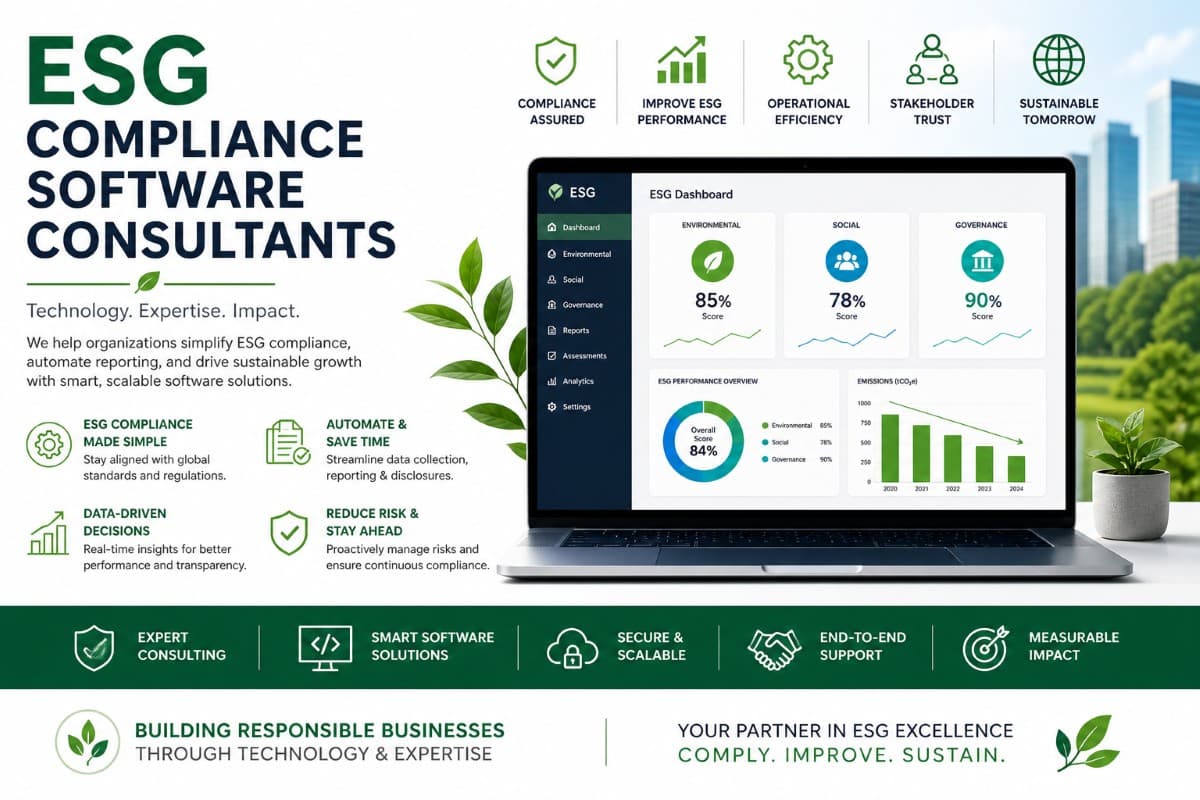
Looking for ESG consultants? Learn what they do, how they work, and how ESG compliance software helps businesses manage reporting, risks, and audits.

Explore real thoughts on compliance software, its role in risk management, audits, and how ESG compliance software helps businesses stay organized and ready.

Learn how to manage compliance with simple systems, clear workflows, and ESG compliance software to stay audit ready and reduce risk across your business.