Centralized ESG Compliance: Track And Manage Sustainability
Use centralized ESG compliance software to track sustainability goals, streamline reporting, monitor performance, and ensure regulatory responsibility.
The construction of a credible ESG compliance programme constitutes, for most organisations encountering the discipline for the first time, a more substantial undertaking than the procurement of software alone might suggest. The programme is, in its essential character, a governance architecture: a structured arrangement of policies, controls, data processes, cross-functional accountabilities, and reporting disciplines that ensures the organisation can meet applicable legal obligations, substantiate its disclosures to assurance providers, and respond to the evolving expectations of investors and regulators without structural disruption.
This guide presents a twelve-phase blueprint for building an ESG compliance programme suitable for US-based organisations facing SB 253, ISSB alignment, or CSRD obligations. It addresses the regulatory context, the role assignments that determine whether a programme succeeds, and the software landscape that supports each phase. It does not assume prior familiarity with sustainability reporting methodology or the intricacies of materiality assessment.
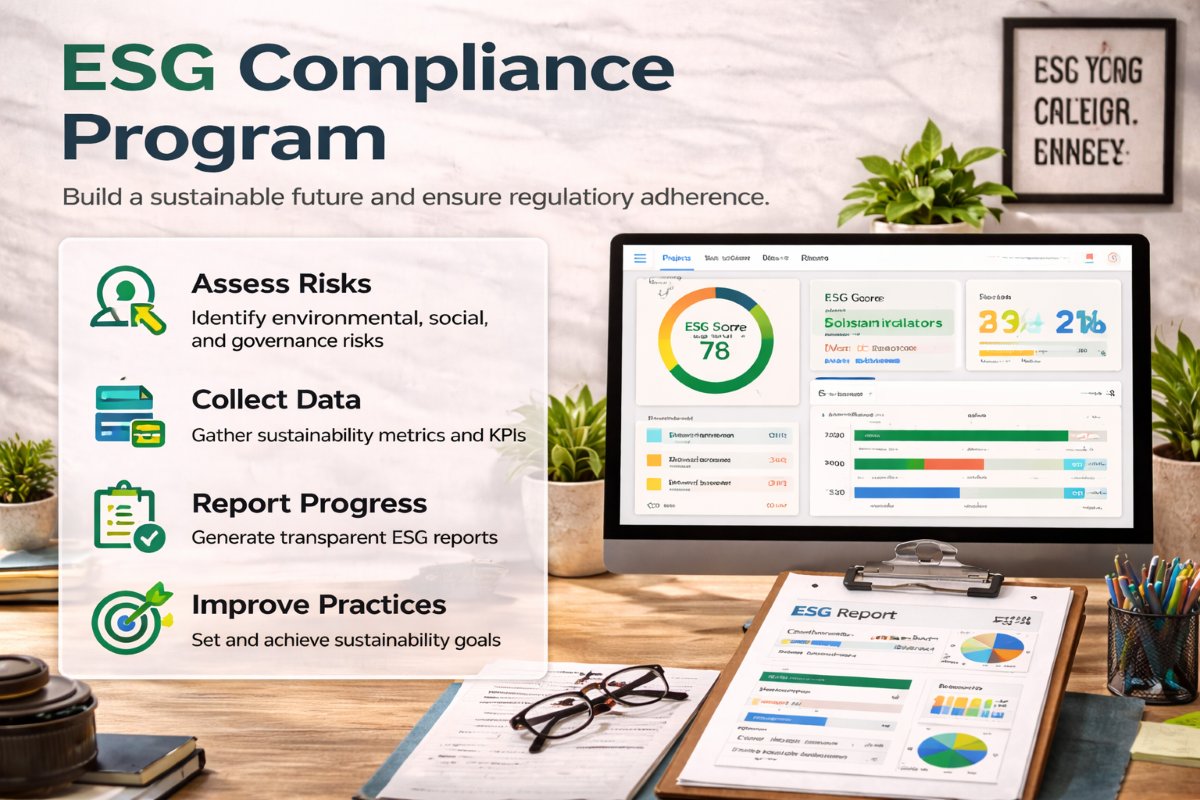
An ESG compliance programme is a coordinated system of governance structures, policies, controls, data systems, and reporting processes that ensures an organisation meets ESG laws and disclosure standards. It differs from an ESG strategy, which concerns sustainability ambitions and targets, and from an ESG reporting exercise, which concerns the periodic production of disclosures. The programme is the ongoing infrastructure that makes those disclosures accurate, auditable, and defensible. Wolters Kluwer's 2025 ESG survey usefully frames the requirements as the "three A's: accurate, auditable, and actionable."
The distinction has become consequential in 2026 because assurance providers the external auditors now required to perform limited assurance on CSRD disclosures and SB 253 reports are not interested in the quality of the narrative. They are interested in the quality of the underlying controls.
The phases presented below represent a synthesis of best practice drawn from EcoVadis, GAN Integrity, Evotix, Compliance and Risks, and independent practitioner guidance. They are sequential in conception but iterative in practice; most organisations will be running several in parallel at any given point.
Governance and executive sponsorship. Secure Board or Audit Committee oversight, designate a cross-functional ESG steering committee, and assign a named executive sponsor (typically the CSO or CFO, or both jointly).
Regulatory and stakeholder scoping. Identify all applicable laws and frameworks by jurisdiction, listing, industry, and revenue threshold. Map investor expectations by analyzing institutional shareholders' ESG requirements.
Materiality and double-materiality assessment. Assess which ESG topics are material from a financial perspective (inside-out) and which carry significant impact on society and environment (outside-in). CSRD requires both; ISSB requires financial materiality; SB 253 requires emissions regardless of materiality.
Regulatory gap analysis and program roadmap. Compare current reporting capability against applicable standards. Quantify the data, process, and control gaps. Produce a multi-year roadmap with accountable owners and milestones.
Policy architecture. Establish written policies covering environmental management, human rights and labour practices, governance conduct, and whistleblower or speak-up channels.
ESG data model and collection architecture. Design the data taxonomy, identify authoritative sources for each metric (ERP, HRIS, utility billing, procurement, IoT, travel systems), and implement automated data pipelines where feasible.
KPI framework and target-setting. Define the specific metrics the organisation will track and disclose, including Scope 1, 2, and 3 greenhouse gas emissions under the GHG Protocol and any social or governance KPIs required by applicable frameworks.
Internal controls (SOX analogue for ESG data). Document the controls over ESG data collection, calculation, review, and approval. These controls are the subject of assurance review.
Training, culture, and whistleblower infrastructure. Deploy awareness training across the organisation, including for the Board. Configure a confidential speak-up channel aligned to the EU Whistleblower Directive and equivalent US protections.
Third-party and supplier ESG program. Extend the compliance program into the supply chain through code-of-conduct requirements, supplier questionnaires, and, for large supply chains, integration with pre-validated supplier networks such as EcoVadis or Sedex. This phase is essential for Scope 3 data collection and for satisfying CSDDD due diligence requirements.
Reporting, disclosure, and digital submission. Produce disclosures in the required format and, where applicable (CSRD/ESRS), tag them in iXBRL for submission to the European Single Access Point (ESAP) and national registers.
External assurance and continuous improvement. Engage an assurance provider for limited assurance (required under SB 253 starting in 2026 and the CSRD starting in FY2025), establish a monitoring cadence, and incorporate regulatory horizon scanning to anticipate the transition to reasonable assurance.
A structured view of ESG program phases and the software categories that support each stage.
Programme Phase | Key Software Category | Representative Platforms |
Regulatory Scoping | Regulatory intelligence | Compliance and Risks, Datamaran |
Materiality / Double Materiality | Materiality tooling | Datamaran, Workiva, Novisto, Coolset |
Gap Analysis / Roadmap | GRC / audit management | AuditBoard, Workiva, Diligent ESG |
Carbon Baseline (Scope 1/2/3) | Carbon accounting | Persefoni, Watershed, IBM Envizi, Sweep, Greenly |
Supplier / Scope 3 Programme | TPRM / supplier networks | EcoVadis, GAN Integrity, IntegrityNext, Aravo |
Internal Controls | Controls management | AuditBoard, Workiva Controls, Diligent GRC |
Reporting and Disclosure | ESG reporting platforms | Workiva, Novisto, Microsoft Cloud for Sustainability, Sphera |
External Assurance | Assurance workflow | Workiva, AuditBoard, Diligent, Persefoni |
Board Reporting | Board portals | Diligent Boards, Ideals Board, Nasdaq Boardvantage |
Use this breakdown to map the right tools to each phase of your ESG compliance journey.
The principal drivers of ESG compliance programme investment in the United States as of April 2026 are as follows. California SB 253 represents the most immediate binding obligation for US companies above the one-billion-dollar revenue threshold. The programme must produce an auditable Scope 1 and Scope 2 inventory for FY2025, supported by limited assurance, for submission to CARB by 10 August 2026. California SB 261, which would require biennial climate-risk reports from companies with revenue above $500 million, is currently stayed pending the Ninth Circuit's ruling; CARB advises continued preparation. The SEC Climate Disclosure Rule is effectively inoperative following the SEC's March 2025 decision to cease its defence.
For organisations with European operations, the CSRD (as amended by Omnibus I, Directive (EU) 2026/470, Official Journal of the EU, 26 February 2026) and ESRS are the dominant framework. Wave 1 companies continue on their FY2025 reporting schedule. Wave 2 obligations have been delayed two years under the Stop-the-Clock Directive (EU) 2025/794. Non-EU groups with more than €450 million in EU net turnover and a qualifying EU subsidiary will face CSRD obligations from FY2028 under the revised thresholds. The ESRS simplification process, driven by EFRAG's December 2025 technical advice, is expected to reduce mandatory datapoints by an estimated 61% and Taxonomy datapoints by an estimated 70% (these are preliminary estimates; the Commission's delegated act is expected September 2026).
Perhaps the most underestimated challenge in ESG programme construction is the absence of a clear RACI. The following assignment represents a consensus view drawn from EcoVadis, Ideals Board, and GAN Integrity guidance, with modifications for the US context.
Role | Primary Phase Ownership | Decision Authority |
Board / Audit-ESG Committee | Governance and assurance oversight | Final approval |
CEO + CSO | Strategy, materiality, stakeholder engagement, disclosure narrative | Strategy sign-off |
CFO / Controller | Data architecture, internal controls, assurance preparation, XBRL tagging | Financial data sign-off |
General Counsel | Regulatory interpretation, disclosure controls, CSRD/SB 253 legal review | Legal compliance |
CCO | Policy management, training, whistleblower channel, TPRM, CSDDD/LkSG | Compliance sign-off |
CRO | ESG risk register, ERM integration, climate risk scenario analysis | Risk sign-off |
CPO / CSCO | Supplier code of conduct, Scope 3 data collection, EUDR/UFLPA compliance | Supplier programme |
Practitioners on LinkedIn and Reddit report with some regularity on the structural obstacles that prevent ESG compliance programmes from reaching audit-readiness. Three recur with sufficient frequency to merit specific attention. First, the data integration challenge: pulling ESG data from ERP, HRIS, utility-billing, IoT, procurement, and travel-management systems is the primary source of programme delay. Deloitte's 2024 Sustainability Action Report found that 57% of executives cited data quality as their foremost ESG concern; PwC's equivalent survey placed the figure at "over half." Software alone does not solve this problem; it requires data-governance decisions about authoritative sources and collection methodology. Second, the ownership ambiguity: without a formal RACI, the programme belongs to everyone nominally and to no one operationally. LinkedIn practitioners reporting on CSRD implementation note that the shift from Wave 1 preparation to assurance-readiness consistently stalls where CFO and CSO offices have not agreed on who owns internal controls. Third, the supplier problem: Scope 3 data collection requires suppliers to share emissions data on a timeline they did not originally negotiate, using methodologies that may be unfamiliar to their operations teams. Many Wave 2 practitioners now on Reddit and LinkedIn report feeling "stranded" between Scope 3 reporting obligations they cannot fulfil and suppliers who are unresponsive to questionnaire requests.
A framework such as the GRI, TCFD, or CDP establishes broad reporting principles and guidance categories. A standard such as ESRS, IFRS S1 and S2, or SASB provides specific, auditable disclosure requirements and datapoints against which assurance providers can form a conclusion. The distinction matters for programme design because assurance providers can only test against standards, not frameworks.
For organisations beginning from a low baseline, a programme that satisfies SB 253 limited-assurance requirements for FY2025 data requires approximately six to twelve months of intensive work. A full CSRD-compliant programme, including ESRS double-materiality and iXBRL tagging, typically requires eighteen to thirty-six months from inception for organisations without pre-existing sustainability infrastructure.
Under California SB 253, limited assurance is required for Scope 1 and Scope 2 disclosures from the first reporting cycle (FY2025, due August 2026). Under CSRD/ESRS, limited assurance is required for Wave 1 companies reporting on FY2025 data. Both regimes envisage a transition to reasonable assurance over subsequent years. Voluntary disclosures under GRI, CDP, and ISSB do not have a statutory assurance requirement, though institutional investors increasingly expect it.
The Partnership for Carbon Accounting Financials (PCAF) is an industry-led initiative providing a standardised GHG accounting methodology for banks, insurers, and asset managers to measure and report the financed emissions associated with their lending and investment portfolios. PCAF alignment is required by SFDR and expected by the Net-Zero Banking Alliance and Net-Zero Asset Owner Alliance. Financial institutions building ESG compliance programmes should incorporate PCAF methodology for their financed-emissions disclosures.
For very early-stage programmes with limited reporting obligations, spreadsheets may be adequate for initial baseline data collection. However, they are not appropriate for any programme subject to external assurance requirements, because spreadsheets cannot provide the data lineage, version control, access controls, and audit trails that assurance providers require. The transition from spreadsheets to purpose-built ESG software is typically necessary before the first limited-assurance engagement.
For companies above one billion US dollars in revenue doing business in California: SB 253 has the nearest binding deadline (August 10, 2026). For companies with EU operations above CSRD thresholds: CSRD/ESRS Wave 1 or FY2028 non-EU group obligations. For companies with institutional investors requiring ISSB alignment: IFRS S1 and S2 voluntary reporting should begin in 2026 data cycles. The most efficient approach is a single data model designed to satisfy all three simultaneously.
Use centralized ESG compliance software to track sustainability goals, streamline reporting, monitor performance, and ensure regulatory responsibility.
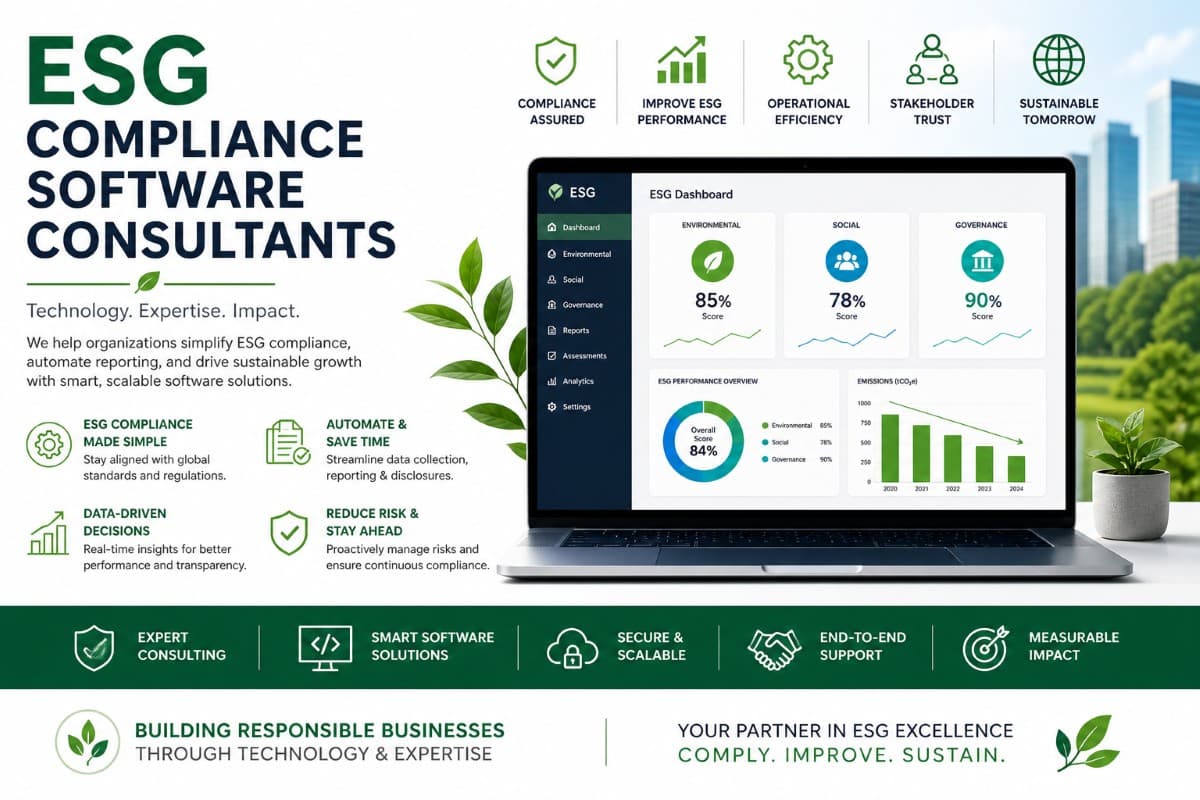
Looking for ESG consultants? Learn what they do, how they work, and how ESG compliance software helps businesses manage reporting, risks, and audits.

Explore real thoughts on compliance software, its role in risk management, audits, and how ESG compliance software helps businesses stay organized and ready.

Learn how to manage compliance with simple systems, clear workflows, and ESG compliance software to stay audit ready and reduce risk across your business.